



The Integrated Public Alert & Warning System (IPAWS) is FEMA's national system for local alerting that provides authenticated emergency and life-saving information to the public through mobile phones using Wireless Emergency Alerts, to radio and television via the Emergency Alert System, and on the National Oceanic and Atmospheric Administration's Weather Radio. Learn more from the IPAWS 101 Fact Sheet.

Myths and Facts
IPAWS is FEMA's national system for local alerting that provides authenticated emergency and life-saving information to the public through WEA, EAS and NOAA Weather Radio. However, misperceptions and myths about IPAWS routinely find their way onto social media and even major news networks.
Review the Myths and Facts
News and Updates
IPAWS Message Design Dashboard Now Available
The Message Design Dashboard (MDD) allows Alerting Authorities to more rapidly draft effective messages – that is, those that are complete, clear, certain and consistent, with the power to motivate action.
Alerting Authorities input pertinent information about their emergency into the MDD, which will automatically produce a draft 90- and 360-character alert based on cutting-edge best practices in crisis psychology and social science research. The MDD is informed by a database of content for more than 50 hazards across a range of domains and includes hazard impact statements and protective action guidance that has been vetted with subject matter experts and reviewed by communication scholars.
New for April 2025, MDD version 2.0 includes categories to facilitate messaging for missing and endangered persons as well as all-clear messages, plus improved functionality for both desktop and mobile users.
View the Dashboard

Refreshed IPAWS For Alert Originators Course
IPAWS is excited to announce that a refreshed version of IS-247: Integrated Public Alert and Warning System (IPAWS) for Alert Originators has been released!
The updates to IS-247 content align with real-world scenarios, improve accessibility, enhance interactivity and adapt assessments to increase learning engagement. These revisions were driven by current practices in the emergency management field, alerting officials’ shared experiences, and valuable feedback provided by the alert and warning community.
Access the Course

Have a Question?
Visit our Frequently Asked Questions page or
Email us. For immediate IPAWS needs, such as alert troubleshooting, call 1-844-729-7522.
Recorded Webinars
All sessions were recorded. If the recording is not available yet in the links below, check back soon.
How IPAWS Sends Alerts
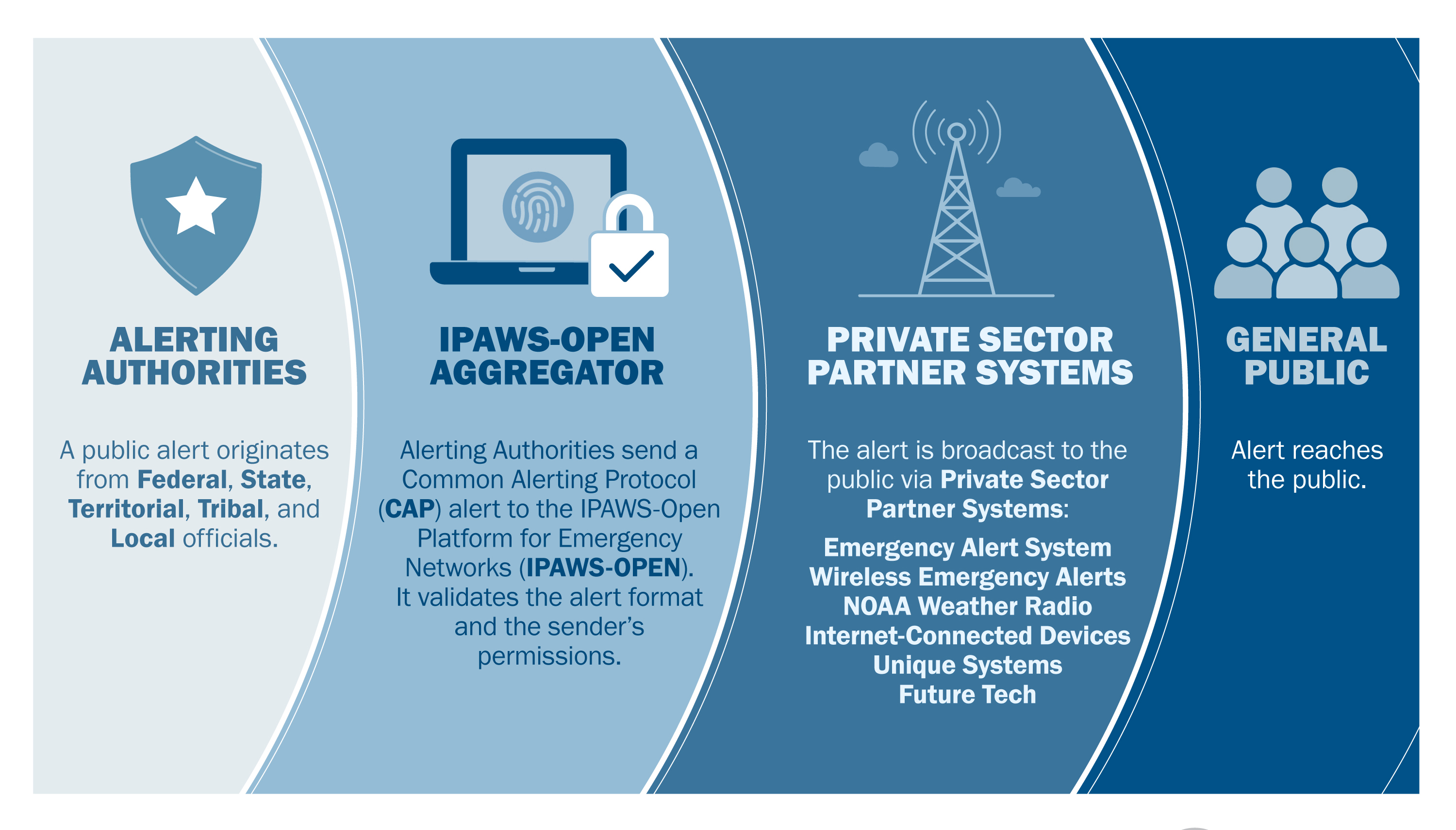
IPAWS allows Alerting Authorities to write their own message using commercially available software that is Common Alerting Protocol (CAP) compliant. The message is then delivered to the Integrated Public Alert and Warning System, Open Platform for Emergency Networks (IPAWS OPEN), where it is authenticated and then delivered simultaneously through multiple communication pathways. Through IPAWS, one message is created to reach as many people as possible to save lives and protect property.
Utilizing multiple pathways for public alerts increases the likelihood that the message will successfully reach the public. IPAWS is structured to facilitate this functionality.
Communication Pathways
The Emergency Alert System (EAS) delivers alerts via AM, FM and satellite radio, as well as broadcast, cable and satellite TV.
Cell phones and mobile devices receive Wireless Emergency Alerts based on location, even if cellular networks are overloaded and can no longer support calls, text and emails.
The National Oceanic and Atmospheric Administration (NOAA) delivers alerts through NOAA Weather Radio.
Alerts are also available from internet service providers and unique system developers.
State, local, territorial, and tribal alerting systems such as emergency telephone networks, giant voice sirens, and digital road signs may also receive alerts from IPAWS-OPEN, and future alerting technologies and systems can easily be integrated into IPAWS.
IPAWS Tools by Audience
Whether you're sending, receiving, developing or communicating about alerts, find the tools you need for your role in the Integrated Public Alert & Warning System.
General Public
- Where You Receive Alerts?
- Wireless Emergency Alerts
- Emergency Alert System
- AMBER Alerts
- Alerting People with Disabilities
IPAWS Program Governance
Broadcasters & Wireless Providers
IPAWS Technology Vendors & Developers
About the IPAWS Program
FEMA established the IPAWS program in 2006 by Presidential Executive Order 13407. Today there are more than 1,800 federal, state, local, tribal and territorial alerting authorities that use IPAWS to send critical public alerts and warnings in their jurisdictions.
Mission
IPAWS is guided by its mission to provide integrated services and capabilities to federal, state, territorial, tribal and local authorities that enable them to effectively alert and warn their respective communities via multiple communications methods.
Vision
To provide trusted timely alert and warning to people affected by threats to public safety in the preservation of life and property.